From discovery to scale Lucent Bio enters 2026 with proven science, farmer validation and a clear path to expanding climate-positive agriculture globally.
Climate-positive agriculture is no longer a distant ideal. It is becoming a necessity, driven by productivity pressure, ESG adoption, and the urgent need to transition to sustainable food systems. As global agricultural production is projected to rise 14% over the next decade, the sector is actively seeking solutions that deliver both economic value and measurable environmental impact.
In that landscape, 2026 marks a defining moment. Not just for climate-positive agriculture as a whole but for Lucent Bio’s ability to scale it.
Why Now? A Global Shift Toward Climate-Positive Solutions
Agriculture is undergoing profound transformation. Sustainability frameworks are becoming required across industries, and funders are prioritizing innovations that deliver measurable environmental and economic outcomes.
Lucent Bio’s mission—to accelerate the transition to a sustainable agri-food system through climate-positive, non-polluting, circular-economy crop inputs—sits directly within this global shift. And in 2025, that mission moved from aspiration to proof.
2025: A Year of Validation and Momentum
Last year, Lucent Bio demonstrated that climate-positive nutrient solutions can perform in both science and in the field. Three achievements in particular signal readiness for scale:
1: Peer review confirmed measurable emissions reductionsA GHGE study validated the environmental benefits of Lucent Bio’s approach, a critical benchmarking step as agriculture transitions toward low-carbon systems. [read more]
2: Farmer adoption demonstrated real-world performance
Canadian test plots demonstrated improved nutrient efficiency, crop resilience, and productivity, supporting early-stage commercialization of Soileos Copper and the emerging Soileos Boron + Zinc formulation for US crops. [read more]
3: Portfolio expansion strengthened market fit
With two new SOileos products addressing widespread micronutrient deficiencies, Lucent Bio entered 2026 positioned as a scalable platform for climate-positive nutrient delivery.
Together, these milestones confirm that the science works, the product performs, and the model is ready for the next stage.
From Discovery to Scale
If 2025 was the year Lucent Bio proved its claims, 2026 is the year the company scales them.
With unique formulations, protected intellectual property, and established manufacturing pathways, Lucent Bio is positioned for broader commercialization while advancing two strategic R&D pipelines that extend impact into new markets.
Soileos (Micronutrients)
Validated in the field and ready for wider deployment in Canada, the United States, and Latin America. Soileos Copper and Soileos Boron + Zinc provide seed-safe, climate-positive nutrition across key broad-acre crops.
Nutreos (Specialty Crop and Seed Treatment Innovation)
Leveraging the same circular economy science, Nutreos is being developed to support nutrient-dense specialty crops and premium markets. This early stage pipeline aligns with global priorities around food quality and nutrient density.
Agreos (Macronutrient Coatings for Broad-Acre Agriculture)
Agreos represents Lucent Bios opportunity to address the largest segment of the fertilizer market, nitrogen, phosphorus, and potassium. This pre-commercial pipeline focuses on improving nutrient efficiency and reducing emission at a broad scale.
Across these categories Lucent Bio’s work extends from micronutrient performance today towards future specialty and macronutrient innovations, laying the groundwork for long term growth.
Our mission has always been to make climate-positive agriculture practical and scalable. In 2025, we proved the science. In 2026, we scale it, expanding our reach, strengthening our portfolio, and deepening our impact across global agriculture.
Global Priorities and a Path Forward
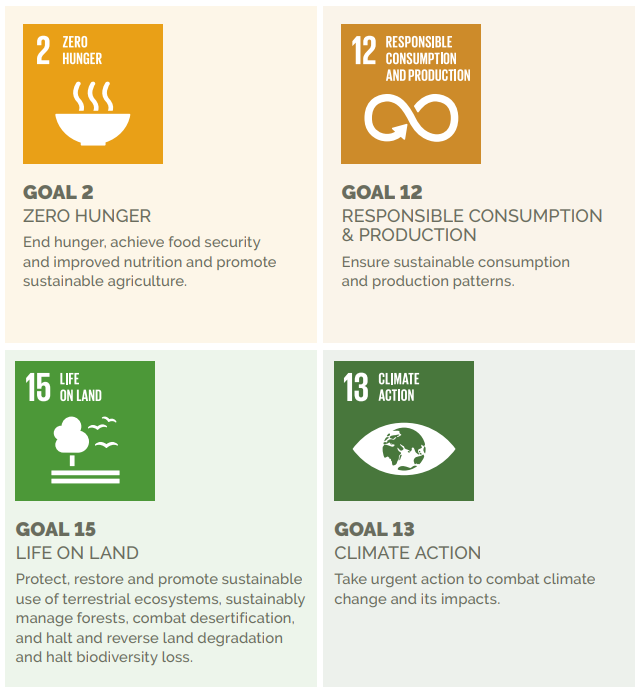
Lucent Bio’s work contributes directly to some of the most urgent agricultural and sustainability goals:
- SDG 2 Zero Hunger: supporting nutrient density and resilient food systems
- SDG 12 Responsible Production: Improving nutrient use efficiency
- SDG 13 Climate Action: enabling measurable emissions reductions
- SDG 15 Life on Land: promote sustainable use of terrestrial ecosystems.
This alignment strengthens the relevance of Lucent Bio’s platform as agriculture transitions toward more sustainable, resilient, and productive practices. Few solutions combine scientific validation, environmental impact and scalability, Lucent Bio is uniquely positioned in that intersection.
This is the year climate-positive agriculture becomes real.
If you share our vision for sustainable, climate-positive agriculture, we invite you to connect with us.
