
How Climate-Positive Wheat Gives Back
Across the agri-food sector, the conversation around climate has long centered on reduction. Lower emissions. Improved efficiency. Smaller footprints. In recent years, this focus has evolved into a collective pursuit of net-zero, a critical and necessary target to balance the carbon books. But neutrality, by definition, is a state of stasis. It means we’ve stopped making things worse, not that we’ve started to make them better.
At Lucent Bio, we believe agriculture can do more than balance the equation. Our research shows it can actively restore it.
Proof in the Soil
In our recently published, peer-reviewed study in the Open Journal of Soil Science, wheat grown with Soileos achieved a measurable climate-positive outcome: each acre stored more carbon in the soil than it emitted throughout the growing season.
Across replicated greenhouse and field trials, we recorded up to 10.4 tonnes of CO₂e sequestered per acre, alongside a 26 percent improvement in soil-carbon balance and a 34 percent increase in microbial activity compared to grower standard practices. These are not modeled projections or offset calculations,they are in-field measurements of soil systems working harder, faster, and more effectively to retain carbon.
What drives this change isn’t a single input, but a living process. By enhancing nutrient availability and feeding the soil microbiome, Soileos creates conditions where microbes can thrive, roots can build stable organic matter, and soils can become genuine carbon sinks. The results confirm what our team has long observed in field trials: the pathway to climate-positive agriculture runs directly through healthy, biologically active soils.
This research marks a fundamental shift in how we think about the role of agriculture in the climate equation. For decades, emissions from food production have been framed as a problem to be minimized. Lucent Bio’s findings turn that story on its head, demonstrating that farming can be a mechanism of restoration.
When soil carbon increases, the benefits cascade through the system. Crops become more resilient to stress, water is used more efficiently, and microbial diversity enhances nutrient cycling season after season. The same processes that store carbon also build healthier, more productive soil ecosystems. It’s a feedback loop of renewal rather than depletion.
This is the foundation of what we call climate-positive farming: agricultural systems that improve the environment each time they are used, rather than exhausting it.
Why “Beyond Zero” Matters
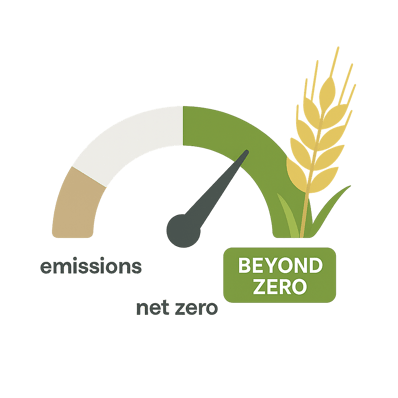 Achieving net-zero is an essential milestone, but it cannot be the endpoint. The science now shows that we have the tools to push further, to design farming systems that restore more than they remove. That’s what “Beyond Zero” represents: not just carbon reduction, but regeneration.
For growers, it means measurable improvements in soil health, productivity, and climate impact within a single season. For the broader agri-food system, it offers a credible, science-backed pathway to sourcing carbon-neutral—and soon, carbon-negative—grains and ingredients. And for the planet, it’s a glimpse into what’s possible when innovation and ecology align.
Looking Ahead
Lucent Bio’s mission has always been to unlock the potential of natural systems through innovation rooted in science. The peer-reviewed validation of our work sets a new model for agriculture itself. “Beyond Zero” is a mindset shift. It’s about moving past mitigation toward renewal, past reduction toward reciprocity.
Because the future of farming won’t be defined by how little we take. It will be defined by how much we give back.